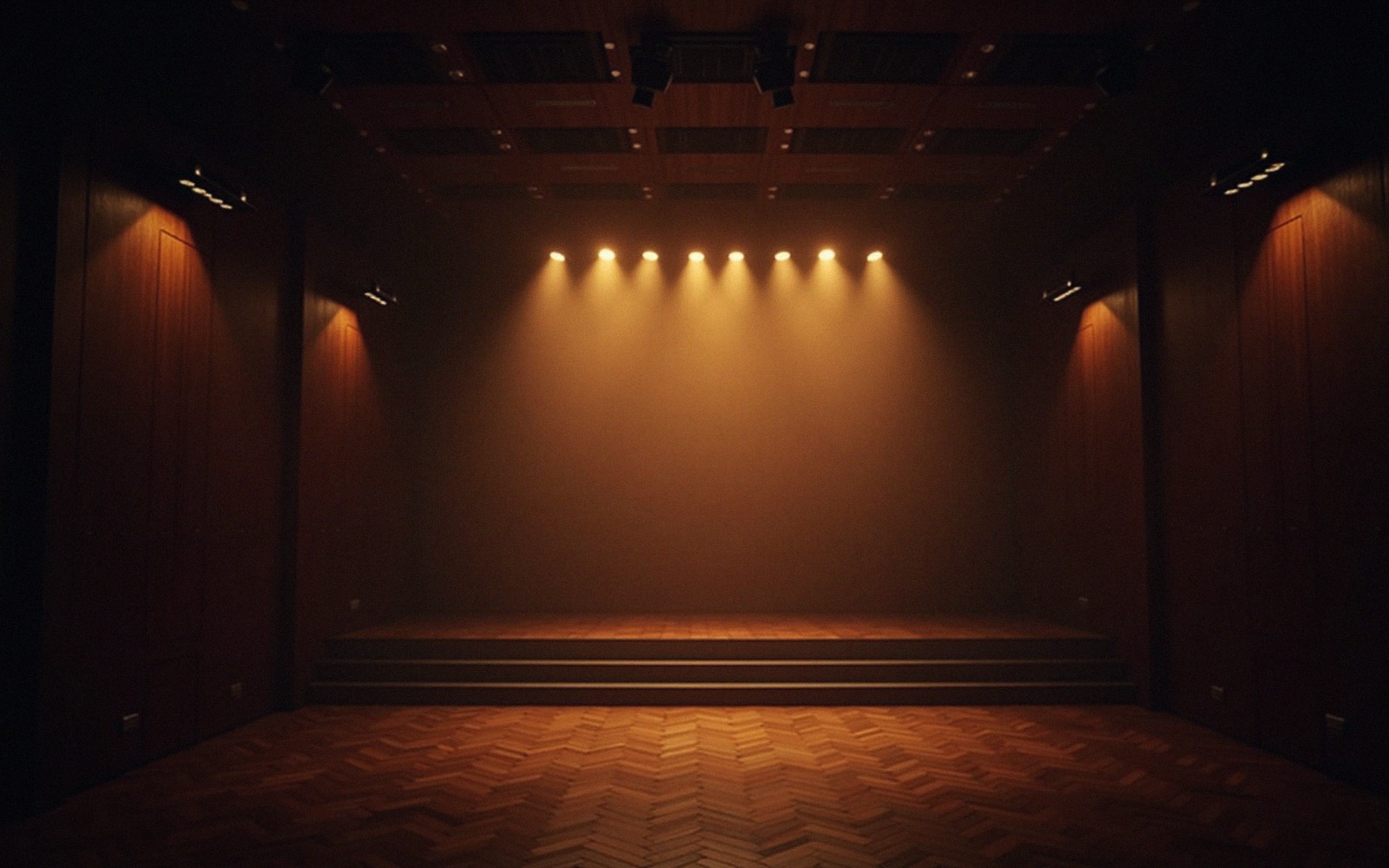
Walk into a great jazz club — the Village Vanguard, the Jazz Showcase in Chicago, Ronnie Scott's in London — and before a note is played, the room is already doing something to you. Low ceiling, worn wood, the smell of the place, the way voices blur into a general murmur. None of that is accidental. It is, in a real sense, the instrument the music is played inside.
01The physics of the room
Every room has a frequency response — the way its dimensions and materials absorb or reflect sound at different pitches. Hard surfaces bounce highs back at you; soft ones eat them. Wood absorbs selectively, warming the mid-range that sits right in the body of a tenor saxophone or an upright bass. A low, curved ceiling can act like the inside of an instrument itself, distributing resonance before it ever reaches your ears. The Vanguard's wedge shape — narrow at the stage, splaying out toward the back — means the sound doesn't just project forward but wraps. Engineers talk about early reflections, those millisecond-delayed bounces that arrive just after the direct signal and give a space its sense of depth and size. In a well-broken-in room, those reflections are your friends.
This is partly why a great small club sounds warmer than a large concert hall, even when the hall has spent millions on acoustic panels. The concert hall is trying to sound neutral. The club accumulated its character over decades: drinks soaked into the floor, cigarette tar into the plaster, the wood of the bar stained and re-stained until it vibrates at its own frequency. You can't build that. It has to happen.
You can’t build that. It has to happen.
02Where to sit
The conventional impulse is to get close — front row, right by the piano, practically inside the bell of the horn. Resist it. Up close, the mix collapses. The drummer overwhelms the bass; the horn is too loud and too directional; the piano's high strings spray past you at an angle. You get a fragment of the band, not the band.
Move back. Find a spot roughly two-thirds of the way into the room, ideally slightly off-center. Here, the room has had time to mix the sound for you. The reflections from the side walls and ceiling arrive fractionally after the direct signal, which is precisely the right delay for the brain to read as warmth and fullness rather than echo. The bass becomes a felt thing, not just a heard one. The piano fills in around the horn instead of competing. The whole ensemble breathes as a unit. Acoustic engineers call the region where direct and reflected sound combine most naturally the "critical distance." In a good club, it lands right around where someone put the tables.
Height matters too. Higher means more ceiling reflection, which tends to add air and shimmer. Lower — at a booth banquette — means you're catching more of the floor bounce, which is darker and thicker. Neither is wrong. They're just different records of the same performance.
03The room as collaborator
Musicians know this. They play to the room, not past it. A bassist adjusting the angle of the instrument's body, a pianist feathering the sustain pedal — these are unconscious negotiations with the acoustic envelope they're working inside. A room that sounds too dry makes players over-project; a room with too much reverb makes them pull back and articulate harder, which changes the phrasing. The room teaches the band how to perform in it, and the band teaches the audience how to listen.
That's the real reason the cheap seat at the back of a small, well-worn room can sound better than the expensive one at the front of a shiny new venue. You're not just hearing the musicians. You're hearing everything the room has learned about the music since the first band played there — the nights folded into the wood, the frequency response tuned across years of performance. The smoke is mostly gone now. The room tone remains.