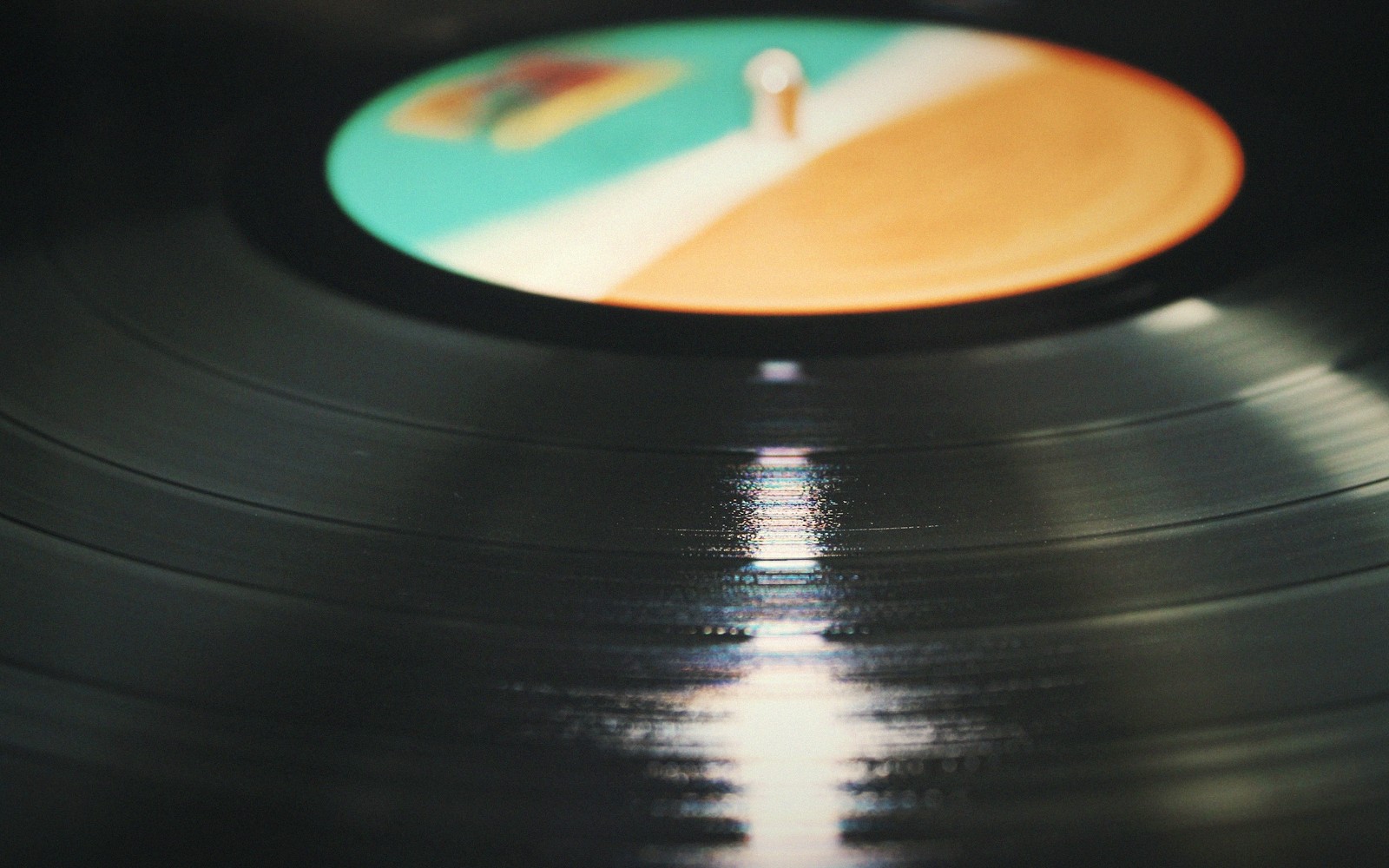
Before the long-playing record arrived in 1948, jazz lived in three-minute increments. The ten-inch 78 rpm shellac disc — fragile, bulky, limited — set the clock. A tune had to fit, which meant soloists trimmed their statements, arrangements were compact by necessity, and the album as we know it didn't exist at all. What did exist was the literal meaning of the word: a bound set of 78s, stacked like photographs in a book, each side holding a separate fragment of an evening.
Columbia's vinyl LP changed the arithmetic overnight. Twelve inches spinning at 33⅓ rpm delivered roughly twenty-two minutes per side — a full forty-plus minutes of music without a single flip or shuffle. For jazz musicians, who had always improvised at far greater length on the bandstand than any recording could capture, this wasn't merely a technical upgrade. It was an open door.
01Two sides, one statement
The effect on composition was immediate and audible. Musicians began thinking not in terms of a song but in terms of a side — a sustained mood, arc, or argument that could breathe across twenty minutes without interruption. The suite form, always latent in jazz, became practical. Thematic material could be introduced, developed, departed from, and returned to in a way that three minutes flatly forbade.
Blue Note, Prestige, and Riverside — the independent labels that defined hard bop's golden stretch in the 1950s — built their entire aesthetic around the twelve-inch LP. A session was sequenced with real intention: tempos varied, keys shifted, the ballad didn't arrive at random but landed where a dramatist might place a slow scene. The cover art, the liner notes, even the album title became part of a unified object. The record sleeve was no longer packaging; it was argument. Listeners began reading the personnel and session dates the way readers annotate a book.
Miles Davis's Kind of Blue (1959) is the obvious landmark, but its genius is inseparable from the format. The five tracks — none technically difficult to enter, all asking something patient of the listener — only cohere as a listening experience when you sit with both sides. The modal approach, with its long melodic plateaus and absence of hurrying chord changes, would have been unintelligible crammed into 78 time. The LP didn't just carry the music; it made the music possible.
The record sleeve was no longer packaging; it was argument.
John Coltrane's A Love Supreme (1965) goes further still. Its four parts — "Acknowledgement," "Resolution," "Pursuance," "Psalm" — form a genuine through-composed arc, a single devotional statement that demands to be heard whole. The suite structure was available to Coltrane not because he was uniquely ambitious, but because the format invited exactly that kind of sustained address.
02The listener's side of the bargain
The LP also changed the audience. To own an album was to commit to an experience of a specific duration — twenty minutes without interruption, then a conscious choice to flip and continue. That pause between sides is itself a kind of form: a breath, a collecting of thoughts, an intermission that the composer could anticipate and use. Some records end their first side on a note of deliberate suspension; others close with such completeness that Side B begins as a new chapter rather than a continuation.
This is the dimension that streaming quietly dissolves. An algorithm doesn't honor the sequence; a playlist doesn't build tension across twenty-minute arcs. The LP was a fixed object with a defined shape, and its best jazz recordings used that shape the way a novelist uses chapters: not just to organize, but to mean. How to Read a Record Sleeve touches on this — the physical object communicates before the needle drops.
None of which is nostalgia for vinyl as a fetish. The argument is structural. When musicians knew they had two sides to fill with a coherent statement, they wrote and played accordingly. The constraint was generative. Jazz found in the LP the same thing novelists found in the novel after centuries of writing pamphlets and poems: a vessel large enough to hold a world, small enough to hold in your hands.